Sulfur Recovery and Tail Gas Cleanup (TGCU)
ProMax contains a complete suite of reactor models facilitating an easy-to-set-up and accurate model of sulfur recovery
unit operations. A kinetic or theoretical approach with empirical modifications allows the user to model real world
behavior, whether for the Claus Process itself or a variety of other Claus/Tail Gas technologies.
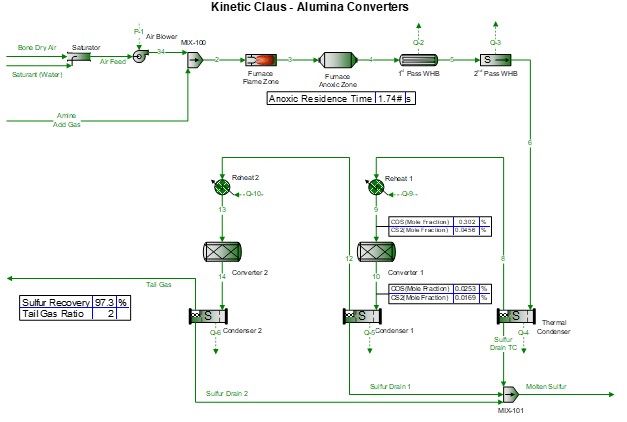
- Model specific Claus configurations such as acid gas bypass, hot gas bypass, enhanced oxygen, catalytic burners, and more.
- Selectox/Recycle Selectox®
- COPE™
- Ultra®
- Sulfreen®
- SCOT®
- SUPERCLAUS®
- MODOP®
- CBA®
- EUROCLAUS®
Benefits
- Directly link the amine, sulfur and tailgas units all in one project
- Optimize plant performance through custom solver routines
- Automatically determine overall plant sulfur recovery
- Easily determine the sulfur dewpoint at any point in the system
- Calculate steam generation and consumption quantities
- Integrate the complete steam system into the simulation
ProMax Sulfur Plant Reactor Applications
ProMax uses built-in kinetic reactions for modeling either alumina or titania catalyst Claus beds along with
predefined constrained Gibbs reaction sets for other reactors to make it very easy for the user to model the
plant. Simply select the reactor type from a drop down list and the appropriate components for that reaction
will automatically be selected for inclusion across the reactor.
Claus Furnace Flame Zone
Empirical method for predicting the concentrations of CS2, CO, H2, Benzene, Toluene, and/or p-Xylene out of the “Flame Zone” region of the Claus furnace.
Claus Furnace Anoxic Zone
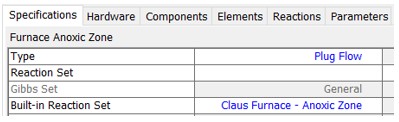
Models the remaining non-combustion group of reactions with built-in kinetics for CS2, COS and NH3. The reactions used are:
- CS2 Destruction
- COS Formation and Destruction
- NH3 Destruction
- Kinetic parameters are available for adjustment in the reactor.
Kinetic Claus Bed
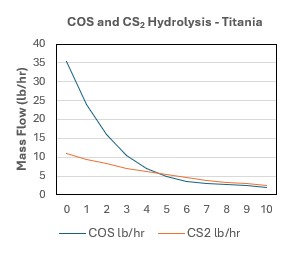
Built-in kinetic reactions for both Alumina and Titania catalyst.
- Claus reaction
- Hydrolysis of CS2
- Hydrolysis of COS
- Sulfur redistribution
Above global reaction rate expressions are derived in terms of adsorption, surface reaction, and desorption steps that occur in the catalyst pore. Kinetic parameters can be customized for the major reaction steps.
Claus Bed
This Gibbs Set has default settings used to model standard Claus beds. The Bypass Fraction parameter is used to effectively set an approach to equilibrium conversion when matching plant data. This type Gibbs Set is not intended to model the first Claus bed since the first Claus bed temperature and catalyst type should be such that COS and CS2 are destroyed.
Hydrolyzing Claus Bed
The default settings for this Gibbs set are intended to model the first Claus bed where the temperature and catalyst type are typically such that COS and CS2 are destroyed.
Acid Gas Burner
This Gibbs Set has default settings used to model the burner at the inlet of a Claus sulfur recovery unit. All Components are included by default. Default Constraints are selected to predict CS2 and COS formation in the burner.
Burner
This can be used to model any type of reactor in a sulfur recovery unit. No constraints are set by default, and all components are Gibbs Reactive (e.g. all components are included in the reaction). This model could be used to model an incinerator or Reducing Gas Generator (RGG).
Sulfur Direct Oxidation
This Gibbs set has default settings intended to model a Selectox type reactor or catalyst burner which can replace the conventional burner for cases with very low H2S. This type reactor is also sometimes used for tail gas applications.
Sulfur Partial Oxidation
This Gibbs Set has default settings intended to model the SUPERCLAUS type direct oxidation bed at the end of the Claus unit.
Sub-Dewpoint Claus Bed
This type Claus bed operates below the sulfur dew point. This Gibbs Set has default settings used to model the 2nd and subsequent Claus beds.
Sulfur Condenser
This type of reactor condenses sulfur species from the vapor to produce a liquid sulfur product. Available sulfur allotropes range from S1 to S8.
Sulfur Hydrogenation
The default settings for this Gibbs Set are intended to model the Tail Gas Cleanup Unit (TGCU) Hydrogenation reactor in which all sulfur species are converted to H2S. The TGCU Hydrogenation reactor is normally used in conjunction with a Reducing Gas Generator (RGG) Reactor for the tail gas. Hydrocarbons and ammonia are the only non-reactive components by default.
Sulfur Redistribution
The default settings for this Gibbs Set are used to model the 2nd pass of the waste heat boiler from about 1200 °F to 600 °F (648.9 °C to 315.6 °C) where the redistribution of sulfur species is the primary reaction.
Sulfur Thermal Reaction Zone
The default settings for this Gibbs Set are intended to model the 1st pass of the waste heat boiler from the burner flame temperature down to about 1200 °F (648.9 °C).